
Lifecycles of Vice Merchants
Common wisdom says vice businesses are recession-proof. People drink, smoke, and gamble regardless of economic conditions. But business registration data tells a more complex story about which vice businesses survive and which ones fail.
Our analysis of 853,797 vice industry registrations reveals dramatic differences in business longevity across sub-sectors. Some vice industries show remarkable staying power. Others experience catastrophic failure rates.
What Counts as “Vice”
This analysis focuses on traditional vice industries with substantial federal and state regulation: alcohol production and distribution (breweries, wineries, distilleries, wholesalers, bars, liquor stores), tobacco (manufacturing and retail), and gambling (casinos, racetracks, gaming establishments).
What’s NOT included: We excluded adult entertainment (strip clubs, adult stores) and cannabis businesses. Adult entertainment has different regulatory frameworks that make cross-industry comparisons problematic (many strip clubs are classified as bars, for instance). Likewise, because Cannabis remains federally illegal despite state legalization, this creates registration patterns that don’t compare meaningfully to other vice categories.
The Survival Landscape
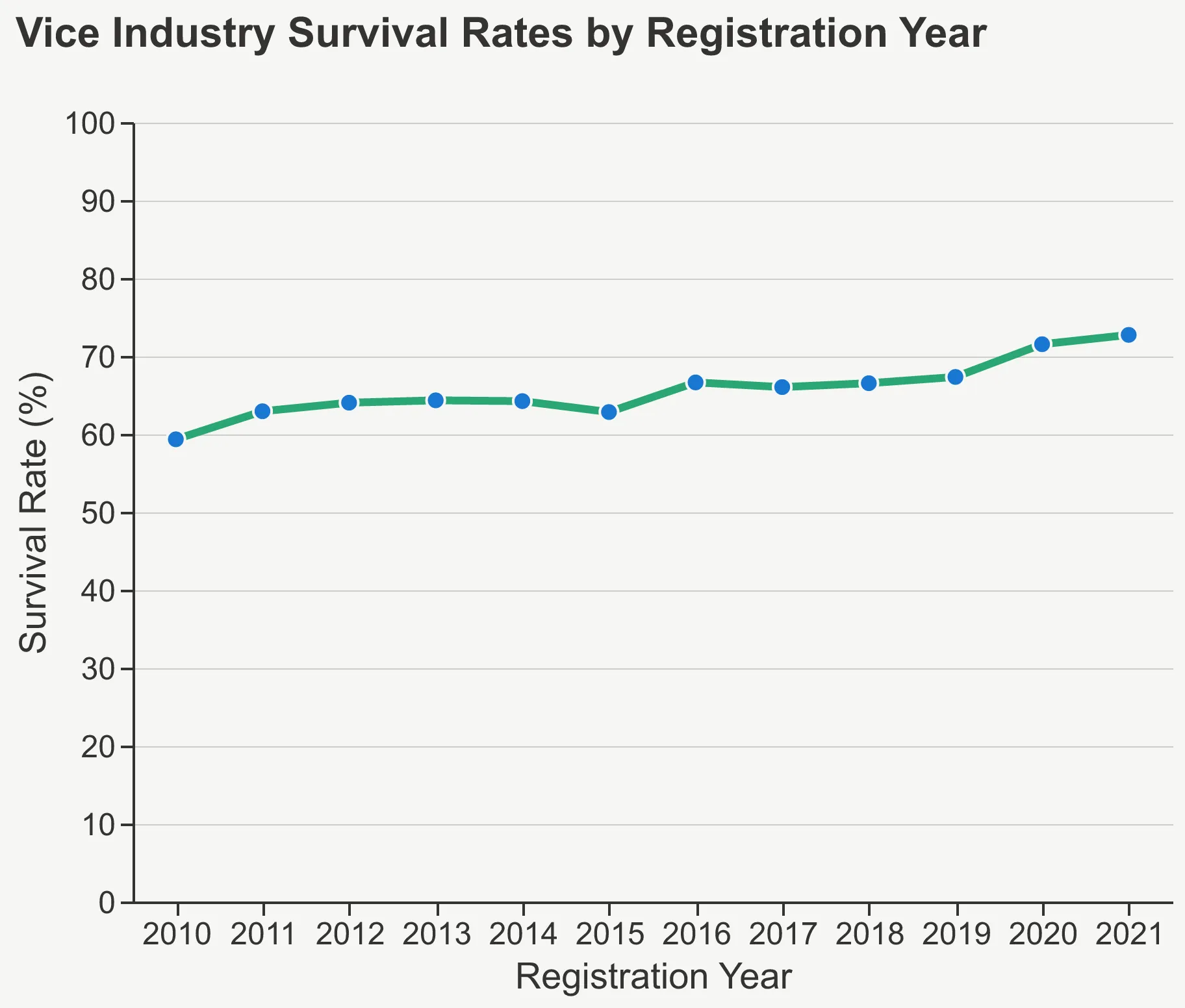
Survival rates for US vice businesses have been trending upwards for years now. Looking at cohorts of newly established businesses and tracking their three-year survival rates, we see that vice businesses established in 2021 had a three-year survival rate of roughly 72% versus just under 60% for those established in 2010.
Of 853,797 total vice industry registrations from 2010-2024:
- 311,382 registrations (68.0%) are currently active
- 137,378 registrations (30.0%) are inactive, dissolved, or expired
- 9,336 registrations (2.0%) have unknown status
But this overall 68% survival rate masks considerable variation by industry type and business model.
The 2015 Cohort: A Natural Experiment
Businesses registered in 2015 are now 9+ years old, providing a natural experiment in long-term viability. These businesses faced normal economic conditions through 2019, then COVID-19 disruption from 2020-2022, then inflation in 2023-2024.
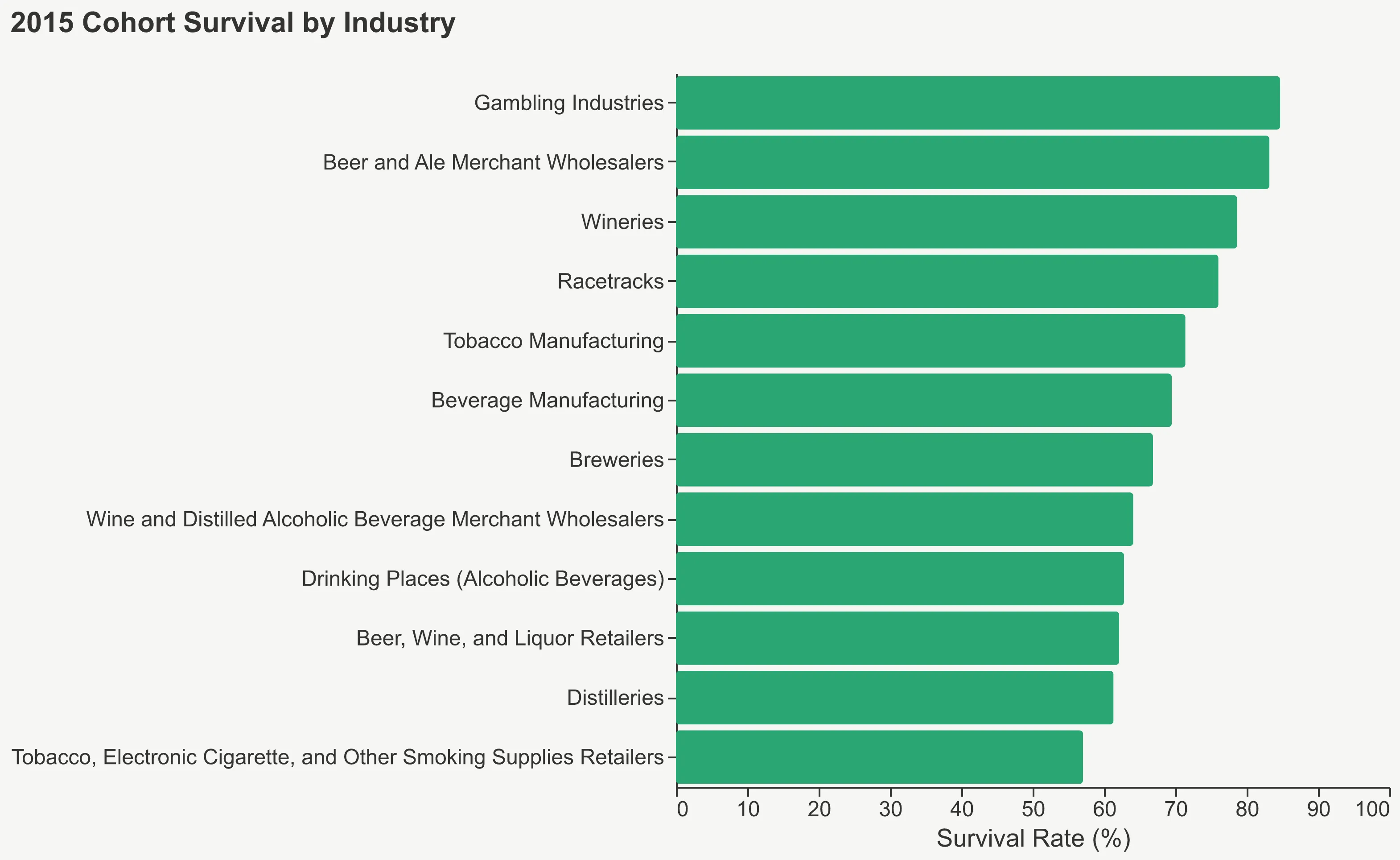
2015 cohort survival rates (9+ years later):
- Gambling Industries: 84.1%
- Beer and Ale Merchant Wholesalers: 81.0%
- Wineries: 78.0%
- Racetracks: 73.0%
- Tobacco Manufacturing: 71.4%
- Breweries: ~75%
- Tobacco Stores: ~55%
The breweries and wineries that started in 2015 weathered all three economic shocks better than tobacco retail or small gambling operations, demonstrating structural resilience beyond just “vice always sells.”
Longevity by Vice Category
Survival rates by industry (2010-2024 cohorts):
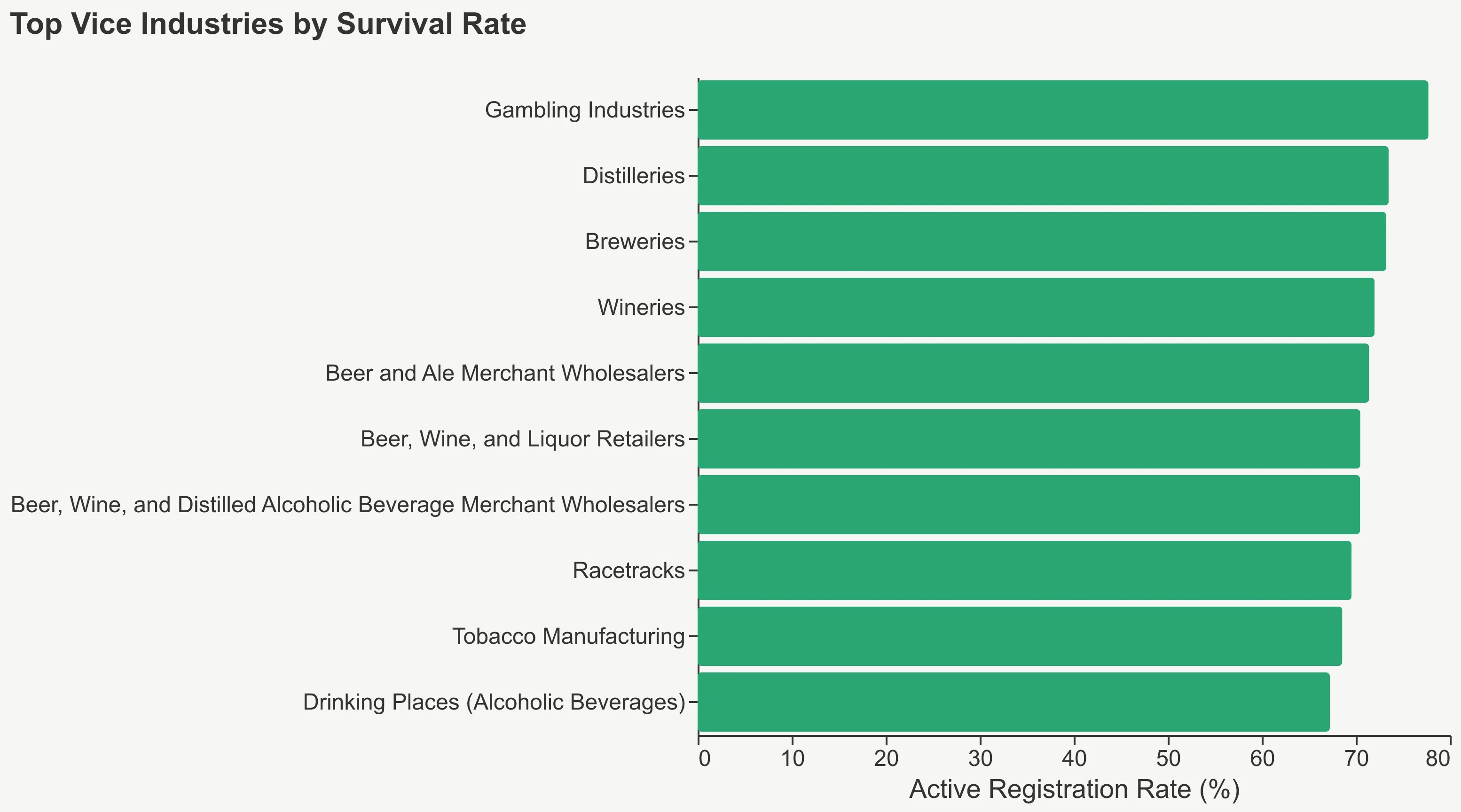
Top Performers:
- Gambling Industries: 77.7% survival rate
- Distilleries: 73.5%
- Breweries: 73.2%
- Wineries: 72.0%
- Beer and Ale Merchant Wholesalers: 71.4%
- Beer, Wine, and Liquor Retailers: 70.5%
- Wine and Distilled Beverage Wholesalers: 70.5%
Lower Performers:
- Other Gambling Industries (non-casino): 47.2%
- Beverage Manufacturing (general): 63.7%
- Tobacco Stores: 64.3%
The pattern is clear: B2B businesses (wholesalers, distributors) outlive B2C businesses (retail stores, bars), while capital-intensive operations (breweries, wineries, distilleries) outlive low-barrier entries (tobacco shops, small gambling operations).
Average Vice Business Lifespan
For businesses that have closed, we can calculate actual lifespan from registration issue date to expiration date. This tells us how long failed businesses survived before closing.
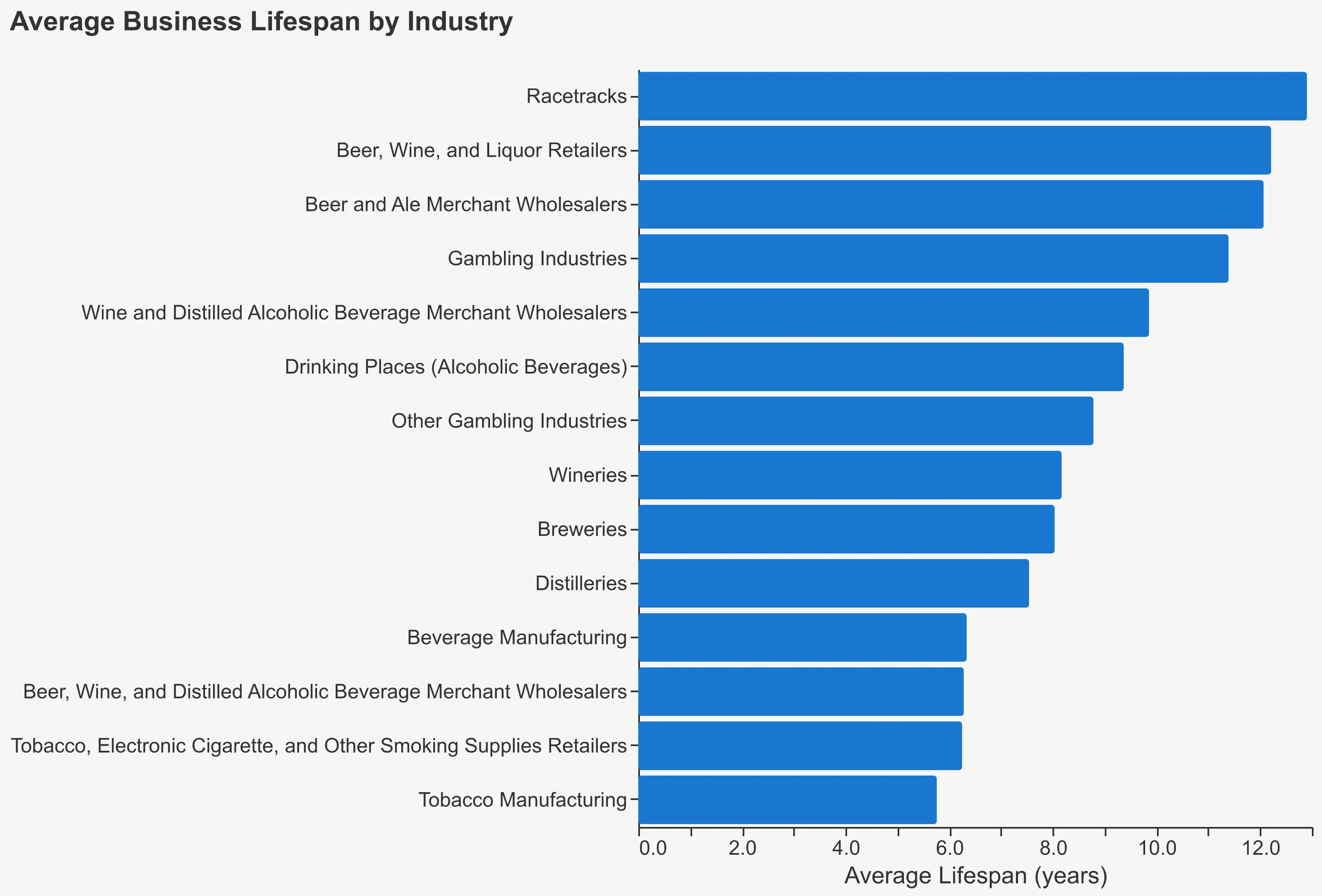
Average lifespan for closed businesses:
- Racetracks: 12.9 years
- Beer, Wine, and Liquor Retailers: 12.2 years
- Beer and Ale Merchant Wholesalers: 12.1 years
- Gambling Industries: 11.4 years
- Wine and Distilled Beverage Wholesalers: 9.9 years
Even businesses that eventually failed in wholesale and distribution lasted over a decade on average. This reflects the sustainability of business models built on regulatory protection and capital intensity. To hazard a guess, racetracks likely closed due to secular industry decline (competition from casinos) rather than operational failure.
Age of Currently Active Vice Businesses
Looking at businesses that are still operating, some industries show surprisingly high median ages:
- Tobacco Manufacturing: 17 years
- Beer and Ale Merchant Wholesalers: 16 years
- Wine and Distilled Beverage Wholesalers: 16 years
- Wineries: 13 years
- Racetracks: 12 years
This suggests an interesting paradox: tobacco manufacturing has the oldest surviving businesses, but that doesn’t mean high survival rates. It means few new entrants (high regulatory barriers) and old survivors. Contrast this with breweries and wineries, which show both old median ages and high survival rates.
Why Some Vice Businesses Survive
Factors correlating with longevity:
1. Capital intensity: High startup costs create barriers preventing over-saturation. A brewery requires significant equipment, real estate, and inventory. A tobacco store just needs a retail lease and inventory. The difference in upfront capital also creates differences in competitive dynamics.
2. Distribution relationships: Established wholesale networks are hard to replicate. Most states require three-tier alcohol distribution (producer → wholesaler → retailer), legally protecting wholesalers from disruption. Breweries can’t easily switch distributors, and new distributors can’t easily steal accounts.
3. Regulatory moats: License scarcity (gambling, alcohol distribution) protects incumbents. In many jurisdictions, liquor licenses are limited by population ratios or require existing license transfers. This caps market entry.
4. Brand equity: Consumer loyalty for breweries and wineries builds over time. Craft beer and wine consumers show strong preferences for specific brands and local producers, creating sustainable competitive advantages.
5. Real estate ownership: Owning vs. renting determines survival during downturns. Businesses that own their production facilities or retail locations survive economic shocks better than those paying market-rate leases.
When Do Vice Businesses Die?
Survival curves reveal different failure patterns by industry.
Most vice businesses that are going to fail tend to do so within the first five years. But timing varies significantly:
- Tobacco retail: Steep early decline, losing 20-25% of businesses in years 1-3. This suggests intense competition and thin margins from day one.
- Drinking establishments: Gradual, steady attrition, losing 10-15% every few years. Bars face consistent challenges (competition, rent, changing consumer preferences) rather than acute early failure.
- Breweries and wineries: Strong early survival, with failures concentrated after year 5-7. Initial capital investment and brand building provide runway, but businesses that haven’t achieved sustainable scale by year 5 face increasing pressure.
This timing matters for investors and entrepreneurs: retail tobacco requires immediate profitability, while breweries can survive initial losses if they achieve scale by year 5.
The Takeaway: Structure Beats Product
Our analysis of vice businesses by sub-industry challenges the myth of uniformly “recession-proof” vice. Some vice businesses thrive due to structural advantages. Others struggle despite selling addictive products.
The difference isn’t what they sell. It’s how they sell it. Distribution beats retail. Capital intensity beats low barriers. Regulation creates moats.
So if you’re betting on vice businesses surviving the next recession, bet on the wholesalers and capital-intensive producers, not the retail storefronts. Demand for alcohol and tobacco may be recession-proof, but business models still determine which specific companies capture that demand profitably.
Methodology
Data Source: Business registration data for vice industries (NAICS codes covering breweries, wineries, distilleries, tobacco manufacturing and retail, gambling establishments, drinking places, beer/wine/liquor retailers, and alcohol wholesalers). Data spans registrations from 2010-2024.
Sample Size: 853,797 registrations. All records include industry classifications.
Industries Excluded: Cannabis businesses (federally illegal, inconsistent state registration patterns) and adult entertainment (different regulatory frameworks).
Survival Rate Calculation: Percentage of registrations with “active” status. Registrations marked inactive, dissolved, expired, or unknown are treated as non-surviving. Unknown status represents approximately 2% of records.
Cohort Analysis: Businesses grouped by registration issue year to control for age effects. Comparing businesses registered in the same year ensures fair comparison. A 2010 business has had 14 years to fail, while a 2020 business has had only 4 years.
Lifespan Calculation: For closed businesses with both registration issue dates and expiration dates. Calculated as days between issue and expiration, converted to years. Limited to lifespans between 0 and 50 years to exclude data errors. Only industries with 100+ closed business records shown for statistical reliability.
Statistical Thresholds: Industries and cohorts with fewer than 50-100 registrations excluded from specific analyses to ensure meaningful results. Exact thresholds noted in each analysis section.
Age Calculations: For currently active businesses, age calculated as years from registration issue date to present (December 2024). Only businesses registered 1990 or later included to avoid extremely old registrations that may represent data artifacts.
Geographic Note: State-level geographic analysis proved unreliable due to businesses registering in one state (often Delaware for tax purposes) while operating in another. Geographic findings excluded from this analysis.
Date of Analysis: December 2024. Survival status reflects business status as of data extraction.
Limitations:
- Registration status may lag actual business operations (businesses may have ceased operations before formal registration expiration)
- Expiration dates not available for all inactive businesses, limiting lifespan analysis to subset with complete date records
- Industry classifications based on NAICS codes, which may not capture all business activities (e.g., a bar that’s also a restaurant)